
Hospital CNA Jobs Near Me: Pay, Requirements & How to Apply
By Mohsin Rabnawaz, founder of SKIMZO
Hospital CNA jobs typically pay $18 to $26 an hour, higher than the national CNA average of $18.96 an hour across all care settings. To qualify, you need a state-approved training program of at least 75 hours and a passing score on the NNAAP certification exam.
Most guides on this topic are either job listing pages that assume you’re already certified, or generic CNA overviews that never address hospital settings specifically. I put this together to actually connect the dots: what it takes to get certified, why hospital CNA jobs pay more than other settings, and where to look once you’re ready to apply.
Why Hospital CNA Jobs Pay More Than Other Settings
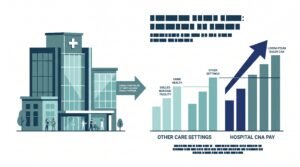
This is the first thing worth understanding, since the pay gap is real and consistent across job postings.
Hospital CNA roles regularly post at $18 to $26 an hour, while the national average across all CNA settings sits at $18.96 an hour, according to Bureau of Labor Statistics data. The difference comes down to environment. Hospitals run faster-paced, higher-acuity units than nursing homes or home health settings, and CNAs there often handle more complex patient monitoring, working alongside registered nurses in units like med-surg, ICU, or telemetry.
Roughly 60 percent of CNAs work in long-term care facilities, which means hospital-based roles are a smaller, often better-compensated slice of the field rather than the default entry point most new CNAs land in.
What a Hospital CNA Actually Does Day-to-Day
Before getting into pay and certification further, it’s worth knowing what the job itself actually involves, since job titles alone don’t tell you much.
Day-to-day, a hospital CNA helps patients with activities of daily living, or ADLs, things like bathing, dressing, eating, and mobility, things patients can’t safely manage alone. You’ll also take and record vital signs, monitor changes in a patient’s condition, and report anything concerning to the nursing team you’re working under. Documentation is part of the job too, often through the hospital’s electronic health records (EHR) system, alongside routine tasks like restocking supplies or helping transport patients between departments.
You’ll also see the title Patient Care Technician, or PCT, used almost interchangeably with CNA in many hospital job postings. In practice, a PCT role sometimes includes a few additional tasks, like drawing blood or performing basic EKGs, that go slightly beyond a standard CNA scope, depending on the hospital’s training and state regulations. If a posting lists “CNA/PCT” together, it usually means the hospital is open to either credential for a role with substantially overlapping duties.
Doing the Math on Hospital CNA Pay
I wanted a real number here, not just a range, so let’s actually run it. If you work full-time at the lower end of the hospital CNA pay range, $18 an hour for a 40-hour week, that’s 18 × 40 = $720 a week, or roughly $720 × 52 = $37,440 a year before taxes.
At the higher end of that range, $26 an hour for the same 40-hour week comes to 26 × 40 = $1,040 a week, or $1,040 × 52 = $54,080 a year. That upper figure sits well above the $39,430 national CNA average, which shows how much the hospital setting specifically can shift your annual take-home compared to the broader occupation.
Many hospitals also offer shift differentials, extra pay for working nights, weekends, or holidays, which isn’t reflected in the base hourly figures above. If a night shift differential adds $2 an hour on top of a $22 base rate, that’s 24 × 40 × 52 = $49,920 a year, a meaningful jump from base pay alone.
| Pay Scenario | Hourly Rate | Annual Estimate (40 hrs/week) |
|---|---|---|
| Lower end, hospital CNA | $18/hr | $37,440 |
| Higher end, hospital CNA | $26/hr | $54,080 |
| With $2/hr night differential (on $22 base) | $24/hr | $49,920 |
| National CNA average (all settings) | $18.96/hr | $39,430 |
I ran these numbers myself rather than quoting a single annual figure, since hourly pay is what actually shows up in job postings for this search, and I wanted you to see how that translates to what you’d actually take home over a year.
What You Actually Need to Qualify
Before you can apply to any hospital CNA job, there’s a certification process to complete, and skipping steps here just delays getting hired. I’m laying this out in the order I’d actually recommend tackling it, not just as a list of requirements.
Federal law requires a minimum of 75 hours of state-approved CNA training, though many states set the bar higher, up to 100 hours or more. Training combines classroom instruction with supervised clinical hours, usually completed at a community college, vocational school, or hospital-affiliated program. Most candidates finish within 4 to 12 weeks, depending on their state and schedule.

| Requirement | Typical Standard |
|---|---|
| Minimum training hours | 75 hours (federal floor) |
| Training format | Classroom + supervised clinical hours |
| Program length | 4–12 weeks |
| Prerequisites | High school diploma or GED, background check, CPR certification |
| Certification renewal | Every 2 years (varies by state) |
What the CNA Certification Exam Actually Involves
Passing the exam is the step that turns training into a real credential, and knowing the format ahead of time removes a lot of the anxiety around it. I’d rather you walk in knowing the real numbers than be surprised by them.
The exam, known as the NNAAP (National Nurse Aide Assessment Program), is administered through testing organizations like Credentia or Prometric depending on your state. It has two parts: a written or oral knowledge test covering your classroom material, and a hands-on skills evaluation where you demonstrate real CNA tasks under observation.
Here’s a number worth knowing before test day. First-time pass rates on the skills portion run around 75 percent, meaning roughly one in four candidates doesn’t pass on the first attempt. That’s not a reason to worry, since most states give you up to three attempts within 24 months of completing training. It is a reason to take the skills practice seriously, though, rather than assume the written portion is the harder half. Passing your exam doesn’t just certify you, it adds you to your state’s nurse aide registry, which is the same registry hospitals and staffing agencies check when considering your application.
Where to Actually Search for Hospital CNA Jobs

Searching “hospital CNA jobs near me” pulls up job board listings, but those aren’t the only place to look, and sometimes not even the best one. I’d start with the channel most searchers skip entirely.
Hospital systems in your area often post openings directly on their own career pages before or alongside job boards. Applying directly can put you ahead of the flood of applicants that job boards attract. Your state’s nurse aide registry, the same list you’re added to after passing your certification exam, is also worth checking, since some states link registry status directly to local job postings or employer outreach. National job boards like Indeed and ZipRecruiter remain useful for casting a wide net, particularly for comparing pay across nearby cities before you commit to one employer.
National job boards like Indeed and ZipRecruiter remain useful for casting a wide net, particularly for comparing pay across nearby cities before you commit to one employer.
Can a Hospital CNA Job Lead Somewhere Bigger?
For a lot of people, CNA work isn’t the final destination, it’s the entry point, and hospital experience specifically tends to carry weight for what comes next. I’ve seen this path work well for people who wanted healthcare experience without committing to years of schooling upfront.
CNA experience is commonly used as a foundation for moving into a Licensed Practical Nurse (LPN) role. It can also lead further, into an Associate Degree in Nursing (ADN) through CNA-to-RN bridge programs some community colleges offer. Working in a hospital setting specifically, rather than a nursing home, exposes you to a wider range of clinical situations, which can make that next step feel less like starting over and more like a natural continuation.
If clinical care isn’t the only direction that interests you, healthcare administration is another path worth knowing about, especially if you eventually want to move from hands-on patient care into managing operations. I’ve broken down what that career path actually pays in my guide to healthcare administrator salary, including entry-level and senior-level figures.
How I Checked These Numbers
I want to be upfront about where these figures came from. The national CNA salary figure is sourced directly from Bureau of Labor Statistics data, not an aggregator’s self-reported average. The $18-26/hour hospital-specific range comes from multiple current job postings across different cities, which I treated as a real-world snapshot rather than an official government figure, since BLS doesn’t break out hospital-specific CNA pay separately from the broader occupation category.
Where older data (a 2021 figure of $33,250 a year) appeared alongside newer figures showing $39,430, I treated this as multi-year wage growth rather than conflicting sources, since both cite BLS as the origin across different years.
The Short Version
Hospital CNA jobs typically pay $18 to $26 an hour, noticeably higher than the $18.96 an hour national average across all CNA settings, largely because hospitals run faster-paced, higher-acuity environments. Qualifying requires at least 75 hours of state-approved training and a passing score on the two-part NNAAP exam, which has roughly a 75 percent first-time pass rate on the skills portion. Beyond job boards, hospital career pages and your state’s nurse aide registry are worth checking directly. For many, CNA work is also a stepping stone toward LPN or RN credentials down the line.
Frequently Asked Questions
How much do hospital CNA jobs pay compared to other settings?
Hospital CNA jobs typically pay $18 to $26 an hour, based on current job postings across multiple cities, compared to a national average of $18.96 an hour across all CNA settings according to BLS data. Working full-time at the higher end of that range works out to roughly $54,080 a year before shift differentials, well above the national average, reflecting the faster pace and higher acuity of hospital units.
What are the requirements to become a CNA?
You need a high school diploma or GED, a passing background check, current CPR certification, and completion of a state-approved training program of at least 75 hours, though many states require 100 or more. Training combines classroom instruction with supervised clinical hours, typically completed in 4 to 12 weeks depending on your state and program schedule, before you’re eligible to sit for the certification exam.
What does the CNA certification exam actually involve?
The NNAAP exam has two parts: a written or oral knowledge test and a hands-on skills evaluation, administered through organizations like Credentia or Prometric depending on your state. First-time pass rates on the skills portion run around 75 percent, and most states allow up to three attempts within 24 months of completing your training program, so one failed attempt isn’t the end of the road.
Where should you actually search for hospital CNA jobs near you?
Beyond national job boards like Indeed and ZipRecruiter, hospital systems in your area often post openings directly on their own career pages, which can put you ahead of the broader applicant pool job boards attract. Your state’s nurse aide registry is also worth checking, since some states connect registry status directly to local job postings or employer outreach you’d otherwise miss.
Can a hospital CNA job lead to a nursing career later?
Yes, CNA experience is commonly used as a foundation for moving into a Licensed Practical Nurse role or further into an Associate Degree in Nursing through CNA-to-RN bridge programs offered by some community colleges. Hospital-specific experience tends to carry particular weight in that transition, since it exposes you to a wider range of clinical situations than most long-term care settings offer.



One Comment on “Hospital CNA Jobs Near Me: Essential 2026 Pay Guide”